
Bridging Seas and Societies: Saros Bay Conservation and Restoration Planning
Yolda Initiative is an international conservation organisation working to protect biodiversity and address climate change in close collaboration with local communities.
With TCEF support, Yolda carried out the project “Bridging Seas and Societies: Saros Bay Conservation and Restoration Planning,” developing a participatory action plan to protect Saros Bay’s marine biodiversity while supporting sustainable small-scale fisheries.
We spoke with the Yolda Initiative team about the project’s origins, multi-stakeholder approach, and its contribution to long-term marine conservation in the Aegean.
Could you introduce your organisation, its mission, and central areas of work?
Founded in 2015, Yolda Initiative is an international conservation organisation working to protect biodiversity and address climate change through scientific research, advocacy, on-the-ground conservation, communications, and partnerships. Grounded in the understanding that humanity—across its full cultural diversity—is an integral part of ecological systems, Yolda focuses on sustainable terrestrial and marine land-use models that support biodiversity conservation and climate action in solidarity with local communities.
Yolda is a member of Together for the Med (TGFM), a regional cooperation network working to reduce the impacts of fisheries on marine biodiversity in the Mediterranean. The organisation also coordinates the Alliance for Mediterranean Nature and Culture (AMNC), which brings together 13 organisations across the region. In addition, Yolda is a member of the International Partnership for the Satoyama Initiative (IPSI) and holds observer status under the UN Convention on Biological Diversity (CBD), the UN Framework Convention on Climate Change (UNFCCC), and the UN Convention to Combat Desertification (UNCCD).
How did the idea for this project emerge, and which social and environmental challenges did you initially aim to address?
The marine and coastal ecosystems of the Aegean Sea are critically crucial for biodiversity and small-scale fisheries. However, despite facing similar pressures, these two domains are often addressed separately. To bridge this gap, we carried out a two-year, participatory marine spatial prioritisation process involving all relevant stakeholders, integrating biodiversity conservation with sustainable small-scale fisheries.
The objective was to identify priority areas in the Aegean where conservation action and investment would have the greatest impact. This scientific assessment revealed areas that are simultaneously critical to biodiversity and small-scale fisheries, are subject to high levels of threat, and have historically been underserved by conservation investment. The findings clearly identified Saros Bay as the area with the greatest conservation and restoration need in the Aegean.
For Yolda Initiative, this result represented a clear call to take responsibility in Saros Bay. The project was therefore designed to develop a participatory Conservation and Restoration Action Plan to safeguard both the region’s rich biodiversity and sustainable small-scale fisheries.
You recently completed the project “Bridging Seas and Societies: Saros Bay Conservation and Restoration Planning.” Could you describe its objectives, activities, and key challenges?
The main goal of the project was to develop a comprehensive Conservation and Restoration Action Plan for Saros Bay that addresses biodiversity and small-scale fisheries within a single, integrated framework.
We began with an extensive literature review and stakeholder analysis, followed by fieldwork and in-depth consultations with small-scale fishers, public authorities, civil society organisations, and academics. In addition, we convened a multi-stakeholder workshop bringing together 39 experts representing these groups to jointly identify threats and co-develop solutions.
The primary challenge was aligning diverse stakeholder priorities and accurately analysing a wide range of interconnected threats. We addressed this by designing a genuinely participatory process, working closely with academic experts, and building trust-based relationships with small-scale fishers. Although rising costs posed financial challenges, we adjusted the budget and allocated additional core funding to ensure that all project objectives were fully achieved.
As a result, we produced a science-based, practical, and multi-actor roadmap for Saros Bay, establishing a strong foundation for the long-term protection of both the ecosystem and sustainable small-scale fisheries.
Your project became part of an international network through the EU’s “Restore Our Ocean & Waters” mission and Mediterranean-scale collaborations. How did these connections contribute to the project, and what are your next steps for Saros Bay?
Recognition under the EU’s Restore Our Ocean & Waters mission provided strong international legitimacy for our work. The Mediterranean and global partnerships developed through the project enabled knowledge exchange, joint research, and collaboration on direct conservation and restoration actions. These networks also increased the visibility and advocacy impact of our work at the international level.
Looking ahead, our priority for Saros Bay is to begin implementing the actions identified in the plan. This includes more detailed planning and on-the-ground work for the protection and restoration of seagrass meadows and coral communities, as well as initiatives to support sustainable small-scale fisheries and address key threats. We also aim to deepen international partnerships as part of a long-term conservation and restoration programme for the region.
How did the multi-stakeholder process contribute to shared learning, and how does this approach influence regional conservation policy?
At Yolda, we prioritise conservation policies that are inclusive, participatory, and aligned with local realities. Throughout the project, we brought together all relevant actors to assess diverse experiences, knowledge bases, and needs jointly. This approach strengthened both the content and the practical applicability of the action plan.
The multi-actor process—bringing together small-scale fishers, public institutions, academics, and civil society—created a strong platform for shared learning and mutual understanding. It enabled threats and solutions to be jointly defined and helped stakeholders better understand one another’s roles and responsibilities, strengthening their capacity for collective action.
As a result, the action plan goes beyond a purely scientific framework. It represents a locally grounded, implementable roadmap shaped by active stakeholder participation. We believe this approach has already contributed to more coordinated, inclusive, and long-term conservation efforts in Saros Bay.
How would you explain the project’s impact to potential supporters? Could you illustrate this impact through a story?
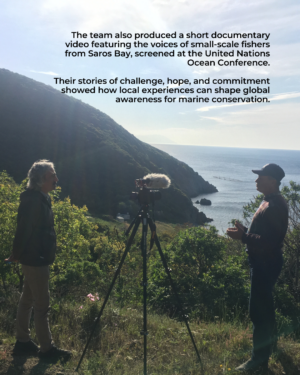
One of the clearest examples of the project’s impact is how a local story from Saros Bay was carried onto an international stage. In collaboration with our global partners, we contributed to a special session at the Third United Nations Ocean Conference (UNOC3), featuring a video that presented the state of small-scale fisheries in Mediterranean countries through the voices of fishers and experts themselves.
The video included small-scale fishers and experts from Saros Bay, recorded during our fieldwork. Fishers spoke candidly about how fishing has become increasingly challenging over the years, while also expressing their hope for recovery and their willingness to take an active role in solutions. The strong engagement the video received on social media demonstrated that the voices of small-scale fishers resonated not only locally but also regionally and internationally.
This example clearly shows how our participatory, multi-actor approach—when combined with real stories from the field—can generate meaningful awareness and tangible impact.